

FAQ Schema vs People Also Ask
Google removed FAQ rich results. That does not mean FAQs are useless, and it definitely does not mean People Also Ask is gone. Here is the clean version of what changed, what did not, and what to do next.

FAQ Schema vs People Also Ask: what's the difference?
FAQ rich results are deprecated in Google Search. People Also Ask is not. FAQPage schema used to make pages eligible for expandable Q&A dropdowns beneath your organic listing. People Also Ask is a completely separate, algorithmically-generated SERP feature that pulls answers from any indexed page based on content quality and relevance — no schema required.
FAQ Schema (specifically FAQPage structured data) was a publisher-controlled markup that told Google "this page contains a list of questions and answers." If Google honoured the markup, it would display those Q&As as expandable accordions directly beneath your blue link. Google stopped showing FAQ rich results in Search on May 7, 2026.
People Also Ask (PAA) is a Google-controlled SERP feature that displays related questions in expandable boxes, appearing in an estimated 40–52% of all searches depending on dataset and date (Ahrefs, Semrush Sensor). Google selects both the questions and the answer sources algorithmically. You cannot opt in with any markup — you earn a PAA placement by having content that directly and concisely answers a question Google considers relevant.
The strategic mistake is treating all question-shaped SERP features as one thing. They are not. FAQ rich results were a display enhancement you opted into. PAA is an answer-source opportunity you earn. Each rewards different work.
What Google actually removed
The confusion starts with language. People say "FAQ schema is dead" when what they usually mean is "Google no longer shows FAQ rich results in the traditional search results."
Those are not the same thing. FAQPage is still a Schema.org type. Google has removed support for the visible FAQ rich result in Search, but the markup itself has not become toxic, spammy, or automatically harmful.
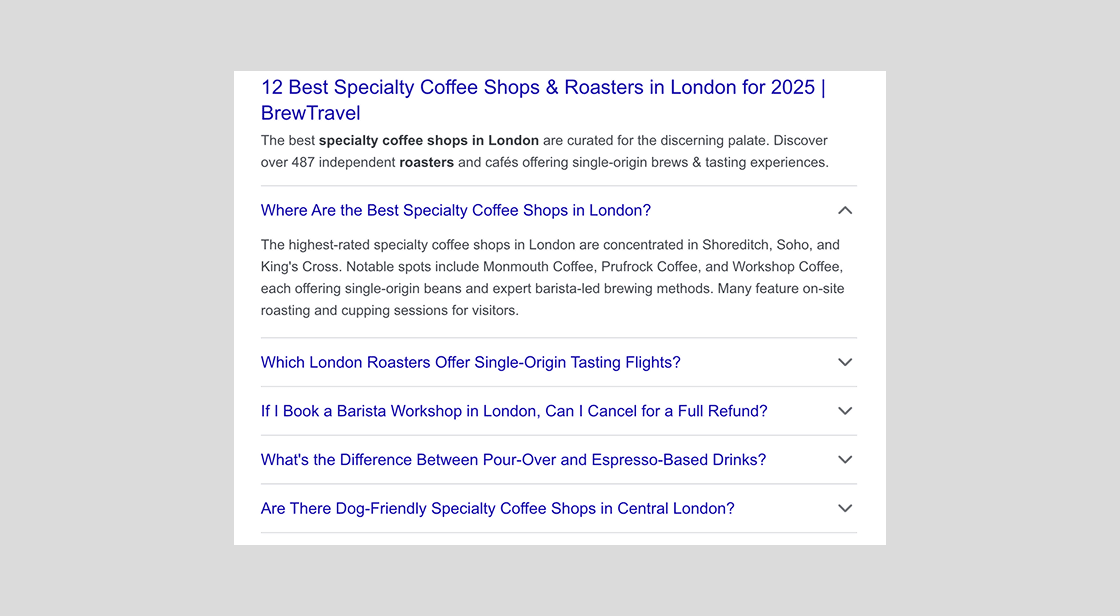
FAQ rich results were attached to your own organic listing and expanded the space your result occupied in Search.
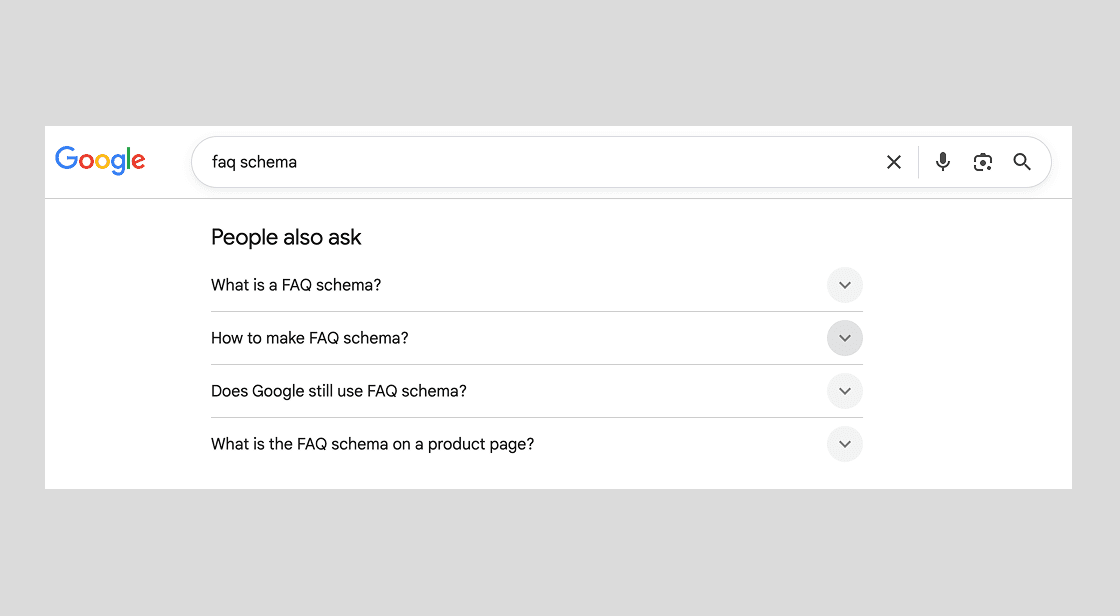
People Also Ask is a separate, Google-controlled question box.
- May 2019
Google launches FAQ structured data support. FAQPage markup can make eligible pages appear with Q&A dropdowns in Search and Google Assistant.
- 2019–2023
Widespread abuse. FAQ rich results were widely used as a SERP real-estate tactic. Product pages, service pages, and landing pages often added thin FAQ sections mainly to win extra dropdown space, pushing competitors further down the page. The barrier to abuse was low and the reward was immediate, which made the feature easy to exploit at scale.
- Aug 2023
Google restricts FAQ rich results. Citing the need for "a cleaner and more consistent search experience," Google limits FAQ rich results to well-known, authoritative government and health websites. For everyone else, the dropdowns vanish overnight.
- May 7, 2026
Google no longer shows FAQ rich results in Google Search. Google adds a deprecation notice to its FAQ structured data documentation. Search Console reporting and Rich Results Test support are scheduled for removal in June 2026, with API support following in August 2026.
- Jun–Aug 2026
Tooling removal. Google removes the FAQ search appearance filter, Rich Results Test support, and Search Console API support over the following months.
"FAQ rich results are no longer appearing in Google Search."
In 2023, Google also made the practical point a lot of sites should remember: unused structured data is not a Search problem. If the schema is valid and represents visible content on the page, there is no emergency cleanup job.
"Structured data that's not being used does not cause problems for Search."
Most sites never benefited from FAQ rich results
This is the part that often gets lost in the deprecation headlines: after Google restricted FAQ rich results to authoritative government and health sites in August 2023, many other sites saw their FAQ enhancement reports flatline to zero impressions.
If your FAQ impressions were already zero (and for many sites, they were), the May 2026 deprecation did not remove a source of traffic. It formalised what had already happened. A late-2024 SearchPilot A/B test found no statistically significant organic traffic impact after removing microdata FAQ schema attributes from inline FAQ content on ecommerce product listing pages. That does not prove FAQ schema is universally worthless, but it supports the idea that once FAQ rich results stopped appearing for most sites, the markup alone was no longer a meaningful traffic lever.
The FAQ enhancement report in Search Console did serve one useful function: it told you whether your FAQPage markup had any validation errors. But it rarely surfaced actual impressions unless your site fell into the government or health categories Google kept eligible after 2023.
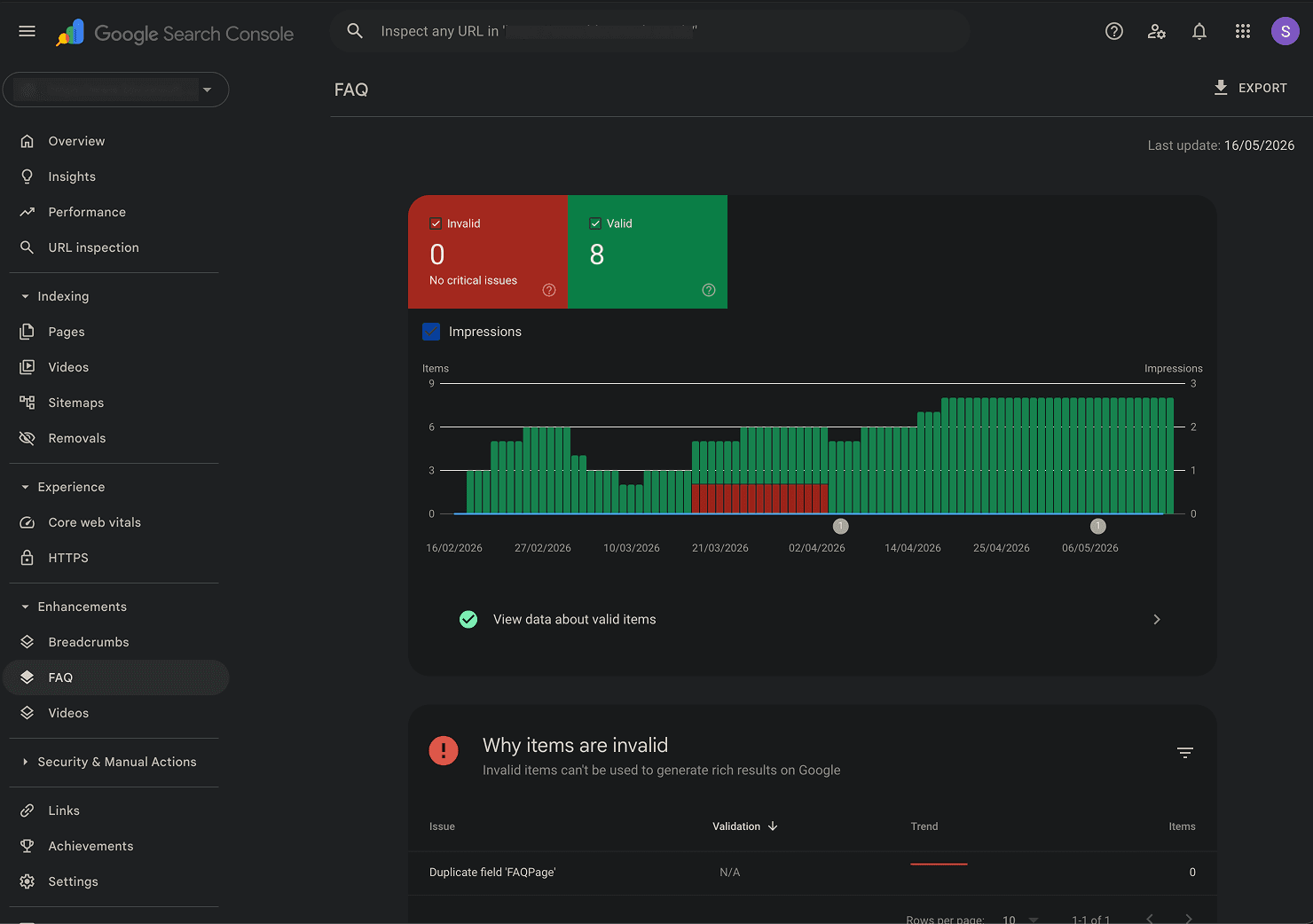
Once Google removes FAQ support from its own rich-result tooling, the validation job changes too. You can still check whether the markup is syntactically valid with the Schema.org validator, and Bing's own tooling remains relevant because Bing Webmaster Tools supports JSON-LD validation. Just do not confuse "valid schema" with "Google will show a rich result."
Is FAQ schema dead?
The FAQ rich result is dead — Google stopped showing it on May 7, 2026. But FAQPage schema markup itself is not deprecated. It still validates, causes no penalties, and may still be useful to other systems that consume Schema.org structured data. Bing supports JSON-LD, so valid FAQPage markup can still provide machine-readable context outside Google's deprecated FAQ rich result. The distinction matters: the visible SERP feature is gone, but the underlying markup remains a valid Schema.org type. You do not need to strip it from your site.
FAQ content, FAQ schema, and People Also Ask
Because FAQ rich results and People Also Ask both involve expanding question-and-answer accordions on the SERP, a massive misconception took root in the SEO industry: people assumed they were powered by the same mechanism. When Google killed FAQ rich results, panic ensued. SEOs thought they were losing their PAA visibility too.
To make a sensible decision, separate the content, the markup, the old rich result, and People Also Ask. They overlap in theme, but they are different mechanisms.
| Item | What it means | Status in Google | What to do |
|---|---|---|---|
FAQ content | Visible questions and answers written for users | Still useful | Keep it when it answers real questions |
FAQPage schema | JSON-LD or microdata describing Q&A content | Still valid markup | Use it if your CMS makes it clean and accurate |
FAQ rich result | Expandable questions below your organic listing | Deprecated in Search | Do not build a strategy around it |
People Also Ask | Google's related-question SERP feature | Active SERP feature | Optimise the answer, format, and page relevance |
Featured snippet | Position-zero answer box for the primary query | Active SERP feature | Different from PAA; see our PAA guide for a full comparison |
The old FAQ rich result was publisher-led: you marked up your own FAQ answers and Google could display them under your result. People Also Ask is Google-led: Google chooses the questions, chooses the source, and can change both without your permission.
Why the confusion persists
The conflation is understandable. There are at least four reasons SEOs keep mixing these up:
- Both involve Q&A on the SERP. FAQ rich results showed questions and answers. PAA shows questions and answers. Visually, they look like cousins.
- SEO tooling groups them together. Many rank tracking and SERP analysis tools categorise both under "SERP features" without clearly distinguishing how they work.
- Practitioners learned about them simultaneously. The mid-2010s SEO curriculum often covered schema markup and SERP features in the same training module, creating an implicit association.
- Featured snippets add to the confusion. Featured snippets (position-zero answer boxes) are yet another question-answering SERP feature. PAA answers are essentially featured snippets for sub-queries, and a page can appear in both. Neither requires schema markup. They are content-driven, not markup-driven.
- Outdated AI-generated advice compounds it. Many AI tools and older blog posts still recommend FAQ schema as a way to "trigger" PAA features. Because LLMs are trained on pre-deprecation data, they frequently provide advice that no longer reflects reality.
Is FAQ schema still worth adding?
If FAQ rich results are dead and schema doesn't drive PAA, should you strip all the FAQ schema from your site? The short answer: keep it if you have it, but do not obsess over it.
"Adding schema produced no major uplift in citations on any platform."
The Ahrefs methodology is worth understanding: they tracked 1,885 pages that added JSON-LD between August 2025 and March 2026, matched against 4,000 control pages using a difference-in-differences design. Across Google AI Overviews, AI Mode, and ChatGPT, schema addition produced changes indistinguishable from noise (+2.4% in AI Mode, +2.2% in ChatGPT). Google AI Overviews actually showed a small decline of -4.6%. The study is the strongest empirical evidence against schema as a standalone AI citation lever.
What FAQPage schema actually looks like
If you have never seen FAQ schema in practice, here is the JSON-LD format that Google's documentation uses. This is the code that CMS plugins like Rank Math and Yoast generate automatically when you toggle FAQ schema on:
1{2 "@context": "https://schema.org",3 "@type": "FAQPage",4 "mainEntity": [{5 "@type": "Question",6 "name": "Is FAQ schema dead?",7 "acceptedAnswer": {8 "@type": "Answer",9 "text": "The FAQ rich result is dead. FAQPage markup is still valid."10 }11 }, {12 "@type": "Question",13 "name": "Does FAQ schema help with People Also Ask?",14 "acceptedAnswer": {15 "@type": "Answer",16 "text": "No. PAA is selected from visible page content, not schema."17 }18 }]19}
The markup is straightforward: each question gets a name and an acceptedAnswer with a text value. Google requires that all FAQ content marked up in schema must also be visible to the user on the page — hidden or dynamically injected Q&As that do not appear in the rendered HTML are not eligible. If your CMS handles this automatically from visible FAQ blocks, it is a low-effort, set-and-forget implementation.
The practical test for any schema type
Edward Sturm, founder of Compact Keywords and host of The Edward Show, framed the FAQ deprecation as a useful critical-thinking test for SEO. The lesson is not "schema is pointless." The lesson is that schema only deserves priority when it connects to a real search feature, user benefit, or business outcome.
"Check in the SERPs for your target keywords if there are special non-normal SERP features."
- If competitors get review stars, product data, or recipe cards, schema may be table stakes.
- If the SERP shows People Also Ask, prioritise visible answers, headings, topical relevance, and answer format over markup.
- If there is no schema-driven feature visible, do not let markup distract from better content, intent matching, and authority.
Other Q&A schema types worth knowing
If your site has user-generated Q&A content — for example, a forum thread or support page focused on one user-submitted question with user-submitted answers — QAPage structured data is a separate schema type that Google still supports. Note that Google is specific about scope: QAPage is for pages with a single question and user-submitted answers. It should not be used on FAQ pages, blog posts, how-to guides, or pages with multiple questions.
Looking further ahead, Joost de Valk has proposed a new FAQSection type on Schema.org that distinguishes between "this page IS an FAQ" (FAQPage) and "this page HAS an FAQ section" (FAQSection as a WebPageElement). The proposal is still early, but it signals where structured Q&A markup may be heading — toward more granular, accurate descriptions of page content rather than full-page type declarations.
FAQ schema and AI search
Some advice now argues that FAQPage schema is more important than ever because AI systems prefer Q&A structure. The evidence tells a more nuanced story.
| Claim | Better reading |
|---|---|
FAQ schema gets you into AI Overviews. | Too strong. Google's AI optimization guide says structured data is not required for generative AI search, and Ahrefs found no major citation uplift after 1,885 pages added JSON-LD. |
FAQ schema is useless now. | Also too strong. Valid schema can still clarify visible Q&A content for machines, and Microsoft has confirmed schema helps Bing/Copilot LLM systems understand content. |
FAQ content helps answer engines. | Yes, when answers are specific, crawlable, concise, and clearly tied to the page topic. The content is what wins PAA and AI citations, not the markup. |
Google's own AI optimization guide is explicit on this point:
"Structured data isn't required for generative AI search, and there's no special schema.org markup you need to add."
The same guide makes a broader point worth internalising: Google's generative AI features are rooted in its core Search ranking and quality systems. As Search Engine Journal noted, Google's position is that optimising for AI search is still SEO — not a separate discipline requiring special markup or AI-specific rewrites.
The most defensible position sits in the middle: optimise the answer block before the markup. If the visible answer is vague, duplicated across the site, or hiding in a generic accordion at the bottom of a page, schema will not rescue it. If the answer is clear, specific, and useful, schema becomes a tidy supporting layer.
The good news is that the content principles that win PAA placements (clear structure, direct answers, topical depth, cited sources) are the same principles that earn citations in AI Overviews, ChatGPT, and Perplexity. This convergence is sometimes called Answer Engine Optimisation (AEO). Optimising for PAA is, in practice, optimising for AI search simultaneously.
Why PAA is the bigger opportunity
If FAQ Schema was your primary SEO tactic for question visibility, you were playing the wrong game. The right game has always been People Also Ask, and it is bigger than ever.
- 40–52% of Google searches show a PAA box. Ahrefs (43%, 2020) / Semrush Sensor (51.85%, 2024)
- Opt-in FAQ rich results required schema markup. Only sites that added FAQPage JSON-LD were eligible
- Earned PAA selects answers from any indexed pag. No markup required. Content quality and structure determine selection
The addressable opportunity is not close. FAQ rich results were only available to sites that implemented schema and only appeared when Google chose to honour the markup. Third-party datasets commonly put PAA visibility at 40–52% of searches (Ahrefs reported 43% in 2020; Semrush reported 51.85% in August 2024), pulling answers from any page on the internet that Google deems authoritative. The total visibility surface of PAA dwarfs what FAQ schema ever offered.
Beyond scale, PAA has a compounding property that FAQ rich results never did. Google often pulls the answer to a specific PAA question from the same source page regardless of which search triggered it. If Google selects your page as the answer for "What is keyword difficulty?", it may use your page for that question whether the user searched for "keyword research," "SEO tools," or "how to rank on Google." A single well-optimised answer can accumulate visibility across hundreds of different queries.
“Ranking in PAA boxes can undoubtedly boost organic traffic, but you need to choose your battles wisely.”
Hardwick’s broader point is that the best PAA targets are questions that recur across many keywords with meaningful combined monthly search volume.
PAA data is a useful proxy for the questions Google already considers worth answering directly on the SERP. Since both PAA and AI Overviews surface question-and-answer content, PAA research may also inform your AI-search content planning. Mining PAA data is not just a SERP strategy. It is a practical input for your broader content operation.
How to win PAA placements
Here is a content-first framework for winning People Also Ask placements. None of it requires schema markup.
- Map the recursive question tree.
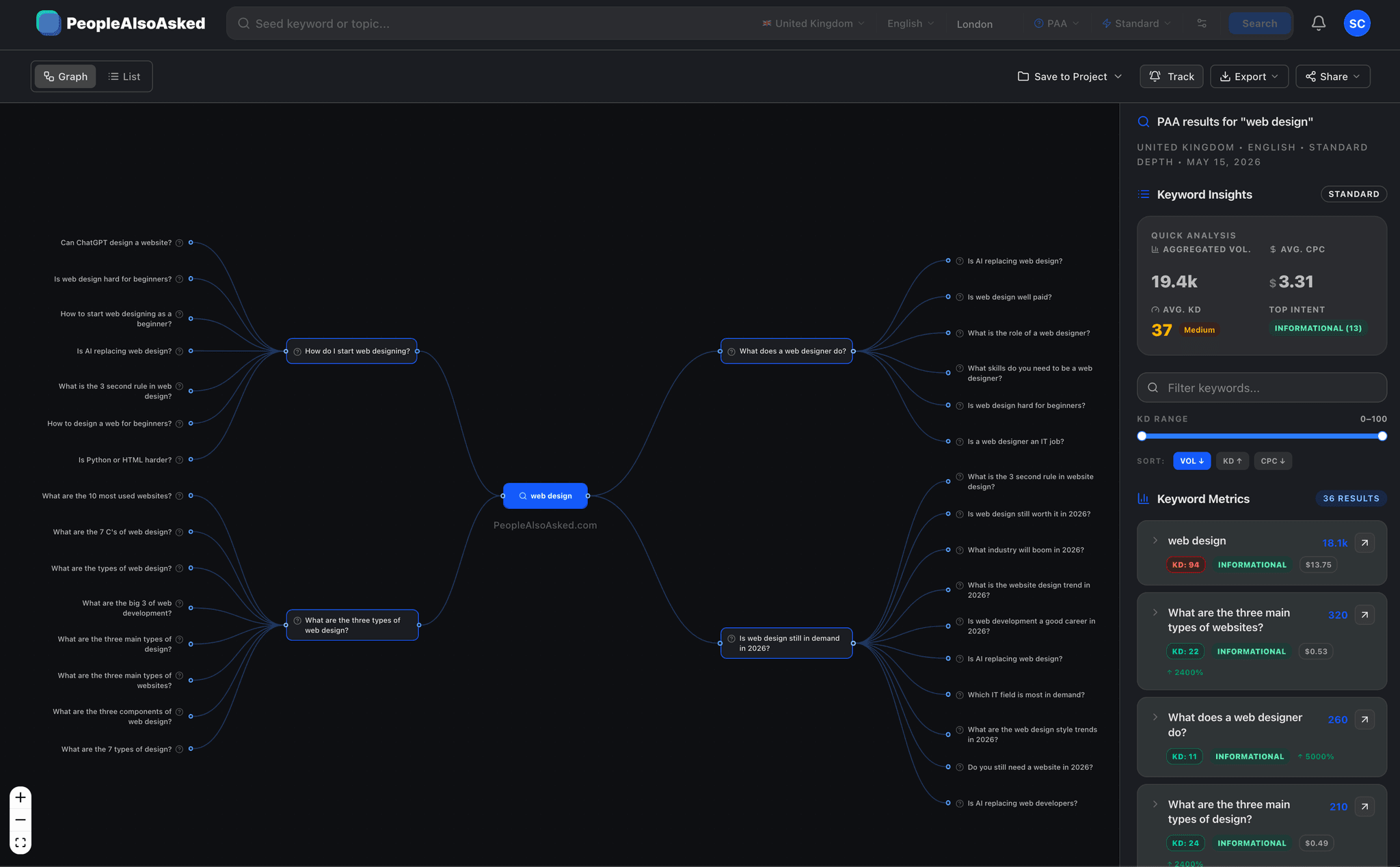
A People Also Ask box is rarely just the first four questions. Clicking a PAA result often reveals another layer of related questions, which gives you a clearer view of how Google connects topics and sub-intents. In PeopleAlsoAsked, a Standard search starts with your seed query, captures the initial PAA questions, and expands them to reveal the next layer of related questions. Deep searches fan out again for broader topic coverage, while Deep+ adds clickstream signals on top. Paid plans also enrich results with search volume, keyword difficulty, and CPC, so you can prioritise the questions that are not only relevant, but commercially worth targeting. - Prioritise questions that appear across multiple queries.
Not all PAA questions are created equal. Focus on questions that recur across several relevant searches, connect to your core topics, or show useful commercial signals such as search volume, CPC, or keyword difficulty. STAT Search Analytics found that 32% of PAA questions have zero measurable search volume, which is why recurrence and topical relevance matter as much as raw keyword data. - Match the answer format Google expects.
PAA answers come in paragraphs, bulleted lists, numbered steps, and tables. Google selects the format based on the question type. "What is" questions get paragraphs. "How to" questions get lists. Comparison questions get tables. Examine the current PAA answer for your target question and structure your content to match. - Use H2/H3 headers as the question, then answer immediately.
The most reliable pattern for winning a PAA snippet is making the exact question a heading (H2 or H3), followed immediately by a concise 40-60 word answer paragraph. Put the definitive answer first. Elaborate and add context afterwards. - Build topical authority through hub-and-spoke content.
Isolated answer pages are harder to support. PAA visibility is more defensible when the page sits inside a broader, well-internal-linked topic cluster. Group related PAA questions into thorough guides, then interlink them with your feature pages and other educational content. - Track your PAA positions over time.
PAA answers are dynamic. Google can swap the source page for a given question multiple times per week. Use PAA tracking to detect when you win or lose positions, so you can react before traffic impact compounds.
Win the SERP features that actually exist
FAQ rich results are gone, but People Also Ask appears in 40–52% of all Google searches. Start mining PAA questions and mapping your content strategy today.
"FAQ rich results rewarded markup. People Also Ask rewards answers." The old game was adding code to your page. The new game is being the best answer to the question your audience is asking.
Common Questions
No, not directly. People Also Ask is not an FAQ rich result and it does not have an opt-in schema type. FAQPage markup may make a Q&A block easier to parse, but PAA selection is about whether Google sees your page as a good answer source for that question.
No. Google removed FAQ rich results from Search. People Also Ask is still an active SERP feature (third-party datasets put PAA visibility at roughly 40–52% of searches) and it is still one of the best places to understand how searchers explore a topic.
Usually, no. Google has said unused structured data does not cause problems for Search. If your CMS already outputs valid FAQPage markup for genuine on-page FAQs, leaving it in place is normally harmless. Other search engines like Bing and AI systems like Microsoft Copilot may still use it.
Yes, if the questions are real and the answers are useful. A good FAQ section can improve the page for users, cover related intent, support internal linking, and make answers easier for search systems to interpret. The FAQ content is the asset; the schema is just a label on the asset.
Start with a short, direct answer in the first sentence, then add one or two sentences of useful context. Use the question as a clear heading (H2 or H3) and match the format Google already shows: paragraph for "what is" questions, lists for "how to" questions, and tables for comparisons.
Nothing directly replaced them. Google removed FAQ rich results to reduce SERP clutter and focus on AI Overviews and conversational search formats. The goal was to provide a "cleaner and more consistent search experience." People Also Ask, which was always a separate feature, continues to thrive.
The evidence is mixed. Google says no special schema is required for AI Overviews. Ahrefs tracked 1,885 pages that added JSON-LD and found no major citation uplift. Microsoft has confirmed schema helps Copilot understand content. The safest position: keep schema as a clarity layer, but do not rely on it as a standalone AI visibility lever.
FAQSection is a new Schema.org proposal from Joost de Valk that distinguishes between "this page IS an FAQ" (FAQPage) and "this page HAS an FAQ section" (FAQSection as a WebPageElement). It is still a proposal and not yet widely adopted, but it signals where structured Q&A markup may be heading.