

People Also Search For Keyword Tool
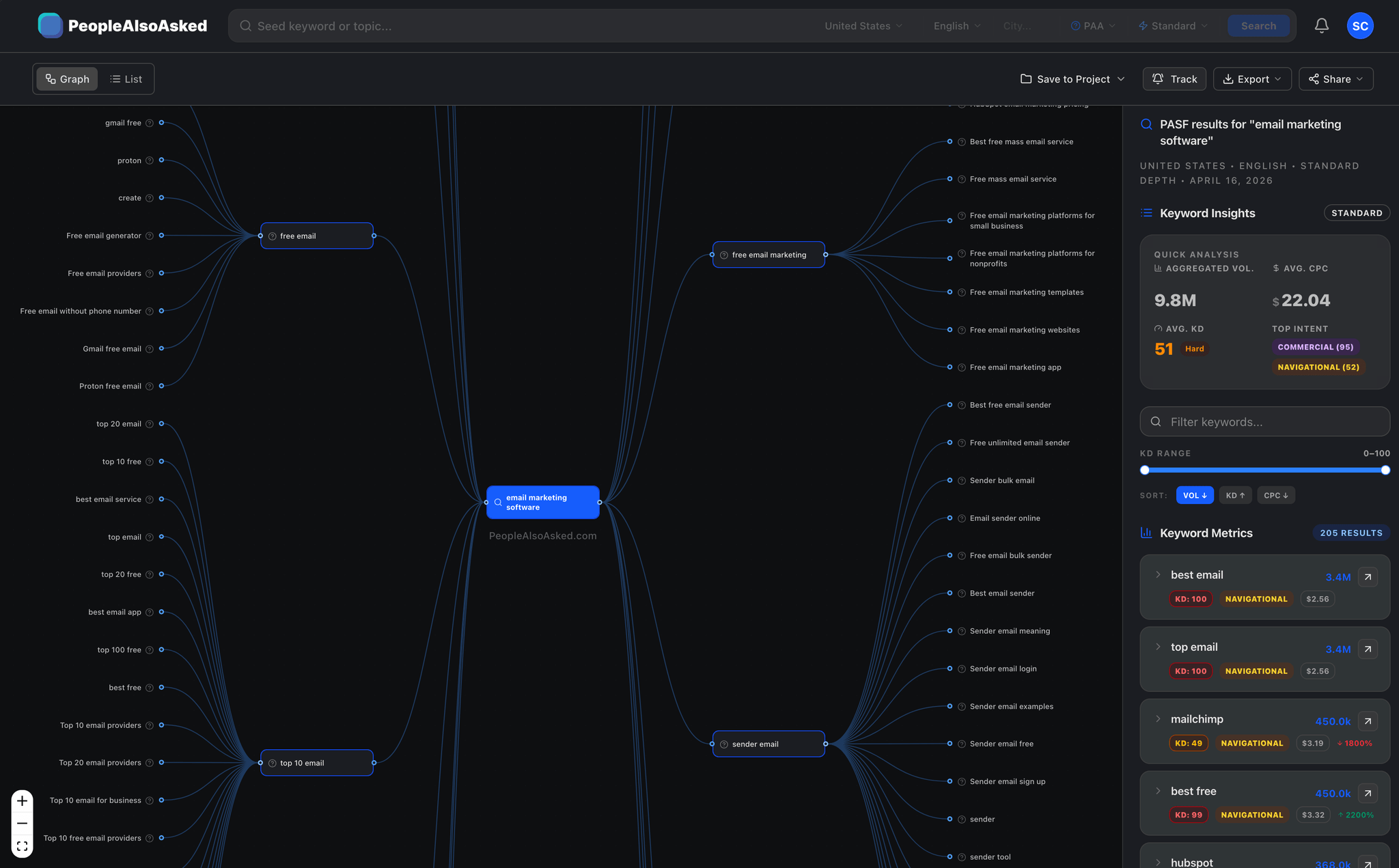
Find what people search next after your target keyword so you can uncover new content ideas, identify adjacent commercial intent, and build pages around real search behaviour. PeopleAlsoAsked turns People Also Search For data into a visual graph with search volume, difficulty, and intent built in.
Why People Also Search For data matters
The follow-up searches are where content gaps hide
Tap into Google's behavioural keyword data
People Also Search For suggestions are triggered by real user behaviour: what people actually search after clicking a result and coming back. This is intent data you can't get from keyword databases, because it reflects how real users refine their searches.
Discover keywords traditional tools often miss
PASF surfaces follow-up queries that emerge from search patterns, not static indexes. Many of these terms have real traffic but are invisible to tools like Ahrefs or Semrush because they only exist in Google's behavioural layer.
Find the content gaps your competitors miss
PASF can help reveal what users still wanted to know after visiting a page. If someone searches your topic, clicks a result, and then refines their search, that follow-up query often points to what the original result did not fully cover. That gap can become your next content opportunity.
Enrich every PASF result with volume, KD, and intent
Raw PASF data is just a list of queries. PeopleAlsoAsked enriches every single term with monthly search volume, keyword difficulty, CPC, and search intent classification. You'll know which follow-up queries are worth targeting before you write a word.
Visualise follow-up searches in a graph
Most PASF tools give you a flat list of keywords. PeopleAlsoAsked turns follow-up searches into a visual graph, so you can see how topics branch, where intent shifts, and which paths lead to new content opportunities.
See how search intent branches from one keyword
One keyword can quickly split into alternatives, feature searches, price-sensitive queries, and commercial comparisons. Mapping PASF visually helps you understand where searchers go next and what pages to create around that journey.
How it works
From keyword to PASF content gaps in 30 seconds
Enter any keyword
Type your seed keyword into PeopleAlsoAsked. Select your target country and language for locally relevant results.
See what people search next
PeopleAlsoAsked pulls live People Also Search For data and turns follow-up searches into a visual graph, so you can quickly spot related topics, intent shifts, and new opportunities.
Enrich and expand the data
Every PASF result includes keyword insights, with deeper layers available for broader expansion and extra data sources like clickstream and Bing. That helps you move from raw suggestions to prioritised opportunities.
Export and turn insights into action
Export your PASF data and use it to identify content gaps, plan supporting pages, improve existing content, or build clusters around real search behaviour.
How we compare
PASF in PeopleAlsoAsked vs other keyword tools
| Feature | PeopleAlsoAsked | Other Tools |
|---|---|---|
Data source | Live Google PASF | Static keyword databases |
Visual mapping | Interactive keyword graph | Flat lists or tables |
Behavioural (post-click) data | Yes | No |
Enrichment (vol, KD, CPC, intent) | Yes | No |
Multi-level fan-out (Deep) | Yes | No |
Country + language selector | Yes | Limited |
CSV + PNG export | Yes | CSV only (most) |
"People Also Search For" (PASF) is a Google SERP feature that appears when you click on a search result and then navigate back to the results page. It shows a block of related queries that other users tend to search for after visiting that same result. Unlike Related Searches (which appear at the bottom of every Google page), PASF is behaviour-driven. It reflects real follow-up search patterns and indicates where a page didn't fully satisfy the user's intent.
They're two separate Google features. "People Also Search For" (PASF) is triggered by a specific user action: clicking a result and then going back. It reflects follow-up search behaviour tied to a specific page. "Related Searches" appear at the bottom of every Google results page and show broader topic associations for the initial query. PASF is more behavioural and intent-specific; Related Searches are more general and always present.
People Also Ask (PAA) shows specific questions with expandable answers in a Q&A format where Google selects a URL to answer each question. People Also Search For (PASF) shows follow-up search queries with no answer attached, just the queries other users searched for next. PAA tells you what questions people ask; PASF tells you what they searched for when the first result wasn't enough.
Yes. PeopleAlsoAsked enriches every People Also Search For result with monthly search volume, keyword difficulty, CPC, and search intent.
PASF keywords represent what users actually search for when a result doesn't fully satisfy them. This makes them a direct indicator of content gaps. If you can cover those follow-up queries within your own content, you reduce bounce-back behaviour and signal to Google that your page is comprehensive. Many PASF terms also have lower keyword difficulty because fewer sites target these behavioural-layer queries.
PASF data is available on all paid plans (Starter, Pro, Agency). The free plan includes standard People Also Ask searches only.
Your competitors already know what people search next.
Stop guessing where a topic leads. Use People Also Search For data to uncover adjacent intent, spot content opportunities, and build pages around real search behaviour.