

Turn People Also Ask into Content Opportunities
Discover the questions people ask on Google, turn long-tail keywords into topic clusters, and prioritize what to create next with keyword insights.
The SEO industry is obsessed with PAA data
People Also Ask questions are one of the highest-signal data sources in SEO — and the best-in-class practitioners have been saying so for years.
65% of Google results include People Also Ask
PAA is one of the most common SERP features in search.
Source: Semrush Sensor
75% of PAA boxes appear in Google’s top 3 results
PAA is heavily concentrated in the highest-visibility rankings.
Source: Semrush
80.92% of AI Overview queries also show People Also Ask
Question-led search is becoming more important, not less.
Source: Ahrefs
Stop wasting hours on guesswork
Traditional keyword research is broken. If you're manually scraping Google or guessing what your audience wants, you're leaving traffic on the table.
The Old Way
- Scrape Google manually and lose hours to repetitive research
- Rely on keyword lists that miss how people actually phrase questions
- Guess search intent instead of seeing real question paths
- Build topical maps slowly, one query at a time
- Publish content with low confidence in what users want next
The PeopleAlsoAsked Way
- Surface real People Also Ask question paths in seconds
- See how a topic expands through related questions and follow-up intent
- Turn live search behavior into structured topic clusters
- Find content gaps earlier and prioritize what to publish next
- Plan content with much higher confidence in audience demand
Turn search questions into content decisions
Discover what your audience is actually asking, map it into clusters, and move from research to publishable opportunities much faster.
Find the questions behind real demand
See how people phrase, refine, and expand a topic across PAA, PASF, and autosuggest.
Turn messy SERPs into clear topic clusters
Map related questions into a logical structure so you can spot themes, gaps, and next-step queries faster.
Prioritize what to create next
Use question-level signals to decide which pages, briefs, and supporting content are worth producing.
Keep research alive over time
Save, schedule, and track important searches so your content strategy stays aligned with how demand evolves.
Extend research with your AI workflow
Send findings into ChatGPT, Claude, or your preferred provider to explore angles, outlines, and briefs.
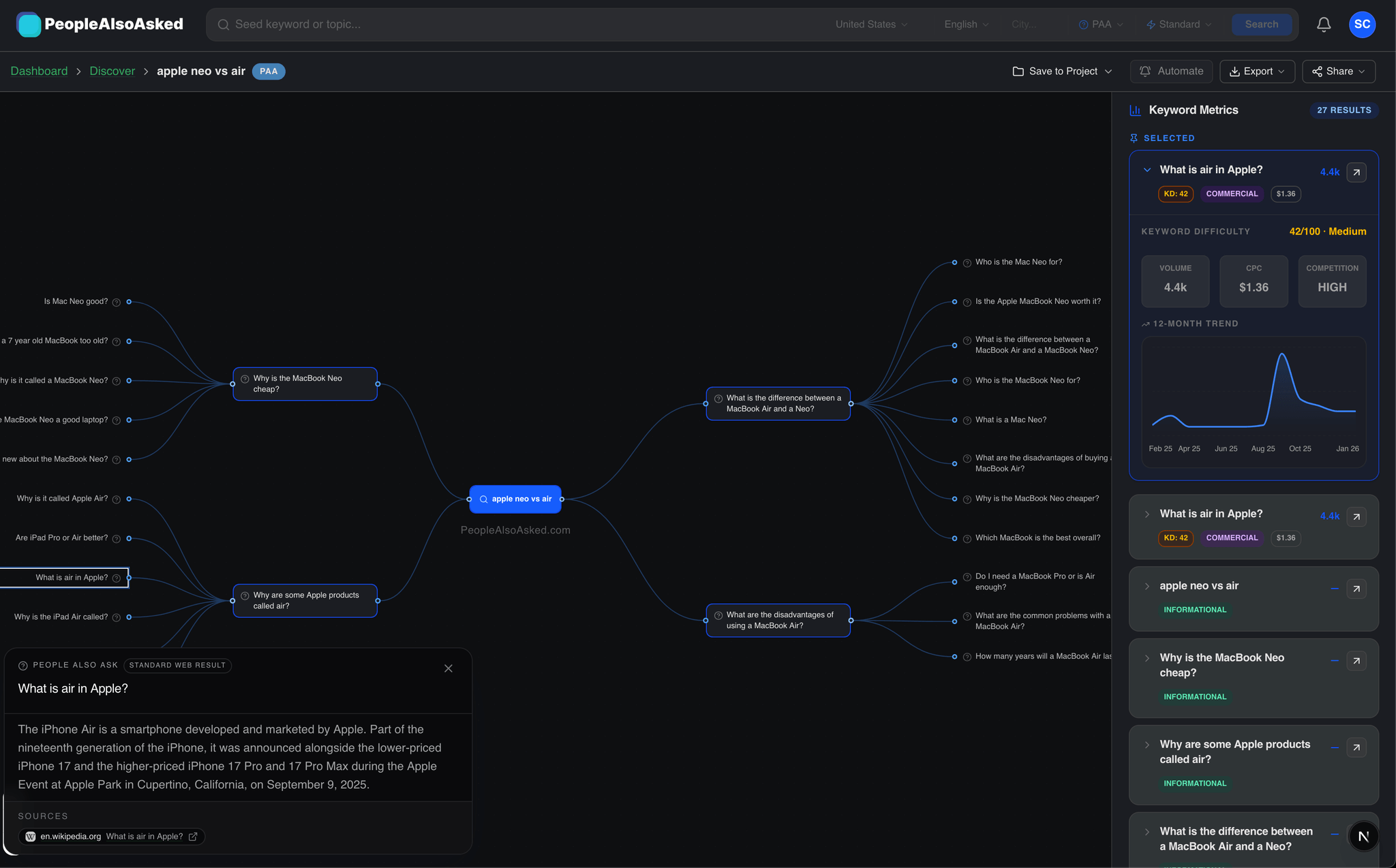
See search intent as a graph, not a list
Understand how questions connect so you can plan content around journeys, not isolated keywords.
How PeopleAlsoAsked works
Start with a topic, explore how questions branch and cluster, then turn those signals into content decisions you can actually act on.
Search a topic
Start with a seed query and pull People Also Ask, PASF, autosuggest, and related search signals into one place.
Explore how questions connect
See how topics branch into follow-up questions, intent paths, and clusters that keyword lists usually miss.
Turn research into action
Save searches, track changes over time, and move findings into content plans, briefs, or your AI workflow.
Why not just use keyword tools?
Keyword platforms are great for volumes, rankings, and broad research. PeopleAlsoAsked is built for something different: understanding how real search questions branch, cluster, and turn into content opportunities.
Traditional keyword tools
Ahrefs, Semrush, and similar platforms
Flat keyword lists
You can see keywords, but it is harder to understand how users refine and expand a topic.
More manual SERP work
Teams still end up opening result pages, copying questions, and piecing intent together by hand.
Harder to see topic structure
It is difficult to spot how questions branch into clusters, supporting content, and next-step queries.
PeopleAlsoAsked
Question-led research workflow
Connected question paths
See how PAA, PASF, and autosuggest branch into related questions and follow-up intent.
Clear topic clusters
Map questions into a structure that makes themes, gaps, and content opportunities easier to spot.
Faster research workflow
Move from discovery to planning without hours of manual SERP digging and spreadsheet cleanup.
Better publishing decisions
Understand what to create next by looking at question patterns, not isolated terms.
Use Ahrefs or Semrush for volume and competition data. Use PeopleAlsoAsked to understand question paths, intent, and content opportunities.
PeopleAlsoAsked is built for question-led research. Traditional SEO platforms are great for rankings, keyword volumes, and backlink data, while PeopleAlsoAsked helps you understand how real search questions branch, cluster, and turn into content opportunities.
No. You can also work with People Also Search For, autosuggest, and related search signals, so you can explore how topics expand across multiple search surfaces.
PeopleAlsoAsked is useful for SEO teams, content marketers, consultants, agencies, and founders who need a clearer way to discover questions, cluster intent, and plan content.
No. If you create content, research topics, or need to understand what your audience is searching for, the workflow is useful even without deep SEO expertise.
It works especially well for blog strategies, topic clusters, FAQ pages, supporting content, and any workflow where understanding real user questions leads to better coverage.
Your competitors are already
mapping your topics.
Every day you spend manually combing through Google, someone else is using PeopleAlsoAsked to claim those keywords first. Start today — it takes 30 seconds.