

Every Related Search Google associates with your keyword
Type a keyword and instantly see every related search Google shows at the bottom of its results page. PeopleAlsoAsked pulls them live, expands them into a visual graph, and enriches each term with search volume, difficulty, and intent.
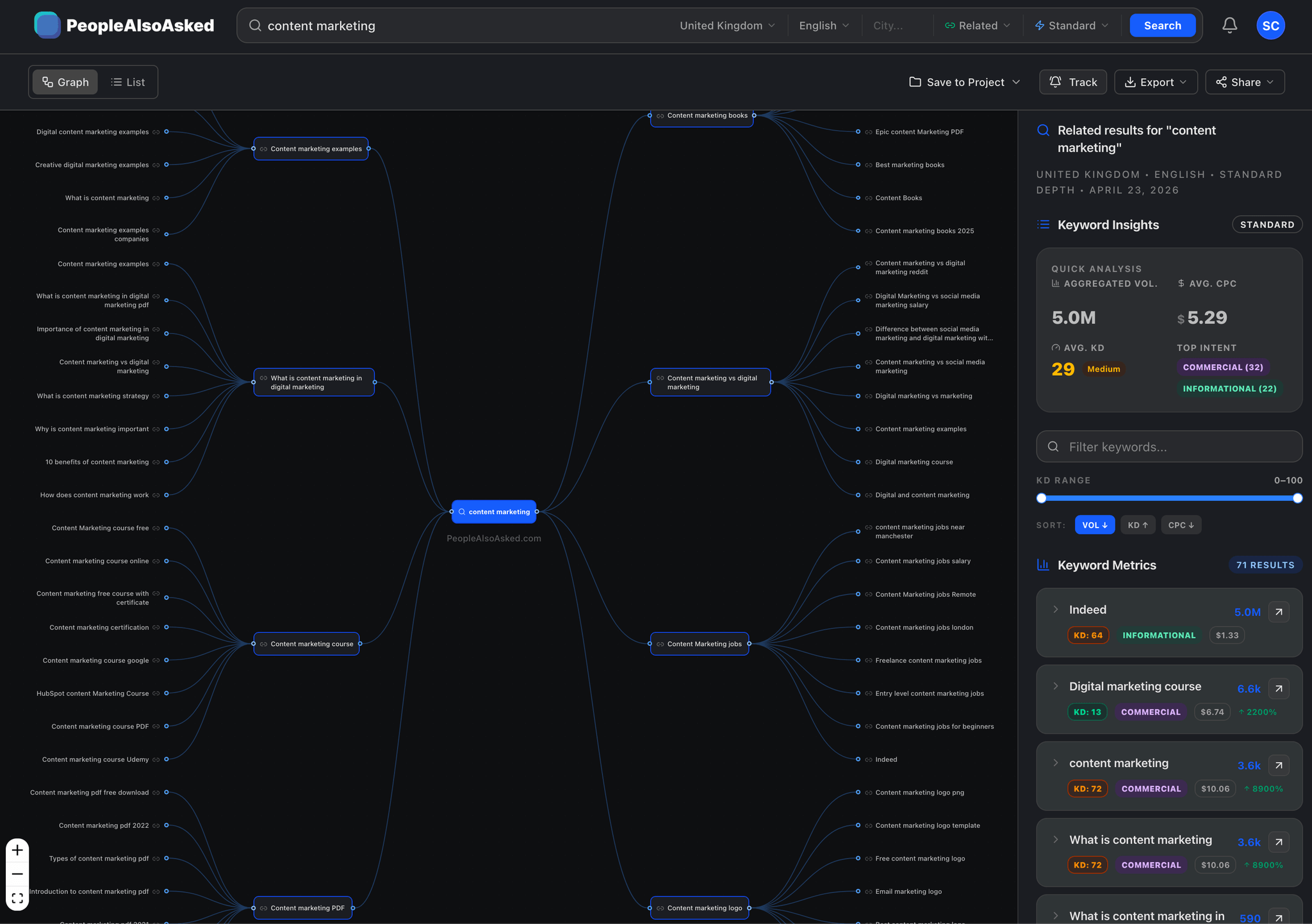
What exactly are Google's Related Searches?
Related searches are the list of queries that appear at the bottom of every Google results page. They show the topics and variations Google considers semantically connected to your search. They're always present, always visible, and they reflect how Google structures its understanding of any topic.
Google is telling you what it associates with your topic
See how Google connects topics
Related searches reveal the broader topic associations Google makes for any keyword. They show you which queries Google considers semantically linked, giving you a map of how the search engine understands your niche.
Find long-tail keywords hiding in plain sight
Every related search is a real query typed by real users. Many of these terms have meaningful volume but are missed by traditional keyword databases because they only exist in Google's associative layer.
Build topic clusters that match Google's thinking
Instead of guessing which subtopics to cover, use related searches as a blueprint. They tell you exactly which angles Google associates with your seed keyword, so your cluster matches how the search engine structures the topic.
Enrich every result with volume, KD, and intent
Raw related searches are just a list of queries. PeopleAlsoAsked enriches every term with monthly search volume, keyword difficulty, CPC, and intent classification so you know which ones are worth targeting.
Spot content gaps your competitors haven't covered
If a related search has decent volume but the current results are thin or irrelevant, that's a gap. Related searches surface these opportunities faster than manual SERP analysis because Google is literally telling you what users want next.
Localised results for any country and language
Related searches differ dramatically by region. The topic associations Google makes in the UK differ from the US, Germany, or Japan. Set your target locale and get culturally relevant keyword data.
The keyword layer most teams overlook entirely
Expand any seed keyword with Google's own topic associations
Use related searches to expand a seed keyword into a comprehensive list of real queries. Instead of relying on keyword databases alone, you get Google's own topic associations, which often surface terms that paid tools miss entirely.
Start with a seed keyword and instantly get 8+ related queries
Use Deep to fan out one extra level of related terms
All paid plans include enrichment (volume, KD, intent) on every result
Export the full enriched list as a CSV content brief
Also search PAA, autocomplete, and PASF as separate graphs
Plan topic clusters that match how Google structures your niche
Related searches give you the exact subtopics Google associates with your pillar topic. Use them to plan cluster pages, FAQ sections, and supporting content that aligns with how the search engine structures information.
Map related searches to plan topic cluster architecture
Use them as H2/H3 candidates for comprehensive pillar pages
Identify "vs" and comparison queries for dedicated pages
Find "how to" queries to create tutorial content
Track related searches over time to spot topic drift
Show clients the content gaps Google's related searches reveal
Pull related search data across client keyword sets to uncover content gaps competitors haven't addressed. Show clients exactly which topic associations Google makes, and use enriched data to build data-backed content plans.
Pull related searches for all client target keywords in bulk
Compare client coverage against the topic map Google expects
Show clients the gaps between their content and Google's associations
Use enriched data to prioritise which gaps to fill first
Export shareable reports with volume, KD, and intent data
From keyword to topic map in 30 seconds
Enter any keyword
Type your seed keyword into PeopleAlsoAsked. Select your target country and language for locally relevant results.
We fetch related searches live
PeopleAlsoAsked queries Google in real time and captures every related search suggestion. Far faster and deeper than scrolling through SERPs manually.
Go deeper and enrich
Use Deep to fan out one extra level. All paid plans enrich results with volume, KD, and intent. Deep+ adds clickstream data and Bing Ads metrics for even deeper insight.
Export and execute
Export the full enriched dataset as a CSV content brief. Use it to build topic clusters, plan pages, or feed into your AI workflow.
Stop scrolling Google manually. Start seeing the full picture.
Scroll, copy, paste, repeat
Manually scroll Google and note related searches
Click each one, scroll again, note more terms
No volume, difficulty, or intent data attached
Copy everything into a spreadsheet by hand
Miss deeper levels because it takes too long
Full topic map, enriched, in seconds
All related searches pulled live in one click
Fan out any term to get deeper levels instantly
Every term enriched with volume, KD, CPC, and intent
Visual graph shows how topics connect
Export everything as a ready-to-use CSV brief
Related searches are the list of clickable queries that appear at the bottom of every Google search results page. They show terms and phrases that are topically connected to your original query, based on what other users commonly search for. Unlike People Also Ask (which shows questions with expandable answers) or People Also Search For (which is triggered by clicking a result and going back), related searches are always present and always appear at the bottom of the page.
People Also Ask (PAA) shows specific questions in an expandable Q&A format, where Google selects a URL to answer each question. Related searches show full search queries (not questions) with no answer attached. PAA tells you what questions people ask; related searches tell you what other topics and variations Google associates with your keyword. Both are valuable, but they surface different types of keyword intelligence.
People Also Search For (PASF) is triggered by a specific user action: clicking a result and then hitting the back button. It reflects follow-up search behaviour tied to a specific page. Related searches appear at the bottom of every Google results page regardless of what the user does. PASF is behavioural and page-specific; related searches are general topic associations that are always present.
Yes. PeopleAlsoAsked overlays monthly search volume, keyword difficulty, CPC, and search intent on every related search result directly in the graph. No need to export to another tool to evaluate which terms are worth targeting.
Related searches are Google literally telling you which topics it considers connected to your keyword. If you want to build topical authority, covering these related terms is one of the most direct signals you can send. Many related search terms also have lower competition because fewer sites specifically target them, making them valuable content opportunities.
Yes. Using Deep (4 credits per search), PeopleAlsoAsked fans out the initial results one extra level to uncover a second tier of related searches. This surfaces niche long-tail terms that are invisible at the surface level. Combine Deep with Deep+ (6 credits) to get both extra depth and clickstream-level metric enrichment.
Related search data is available on all paid plans (Starter, Pro, Agency). The free plan includes standard People Also Ask searches only.
Every day you research manually, someone else is already using this data
Related searches show you how Google connects topics. Stop scrolling to the bottom of SERPs and copying terms by hand. Start today — it takes 30 seconds.