43–52% of Google searches trigger a PAA box
Source: Ahrefs (2020) / Semrush Sensor (2024)


People Also Ask is Google’s expandable question box. This guide explains how PAA works, where answers come from, and why it appears in search results.

People Also Ask is a Google SERP feature that displays related questions in expandable boxes. Each question reveals a short answer, a source link, and often more related questions. SEOs use PAA data to find content ideas, understand search intent, and identify questions worth answering on their own pages.
People Also Ask (PAA) is a Google Search feature that shows expandable questions related to the user's original query. When someone opens a question, Google displays a short answer, a source link, and often adds more related questions to the box.
For users, PAA is a way to explore a topic without starting a new search. For SEOs, it is a highly valuable source of question-led keyword research, search intent data, and content ideas.
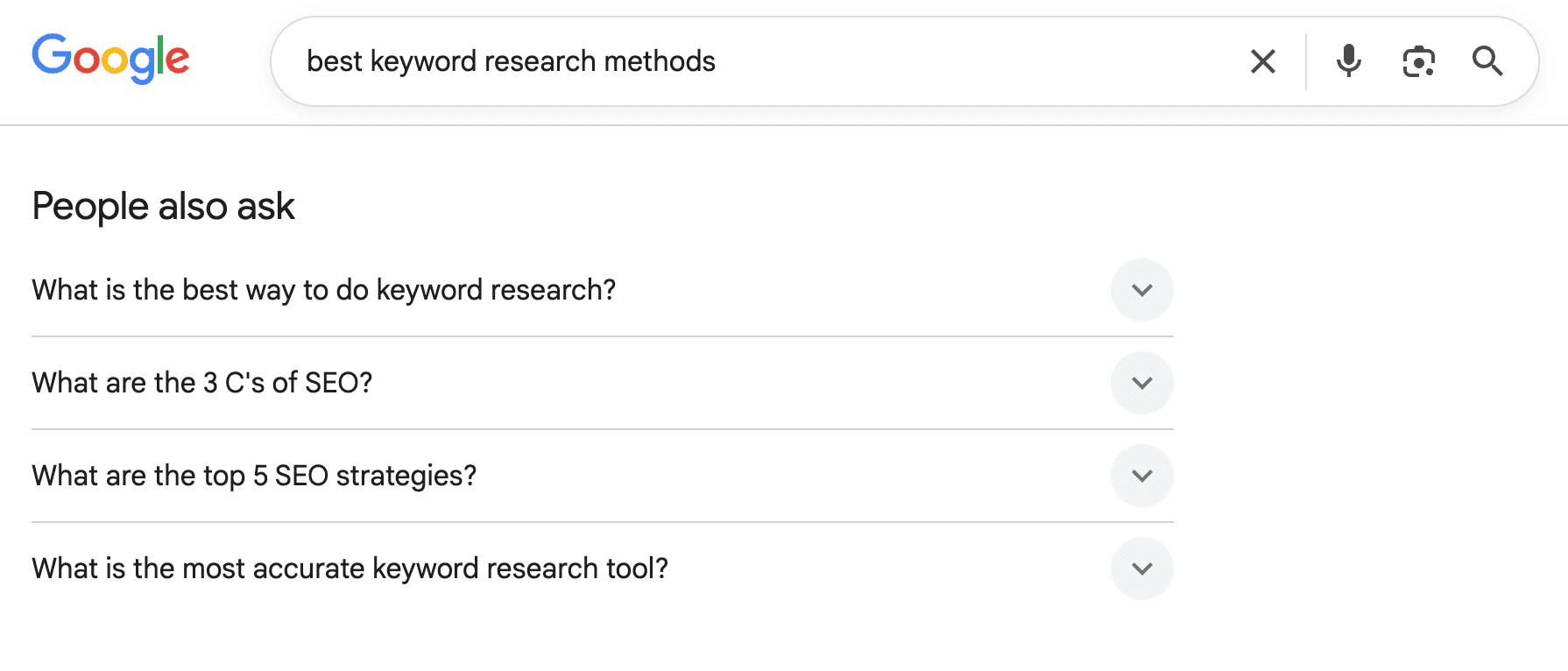
The feature was first introduced by Google in April 2015 and has since grown into one of the most common Google SERP features. Unlike traditional organic results, which display page titles and meta descriptions, PAA boxes provide actual answers on the search results page itself, making them a prominent SERP feature.
"People Also Ask boxes appear in 51.85% of all searches, making them the single most common SERP feature after standard organic results."
PAA boxes are algorithmically generated. Google selects both the questions and the source pages based on factors such as topical relevance, answer quality, source suitability, and how well the content matches the question. There is no way to pay for placement; it is entirely organic. Separate research from Ahrefs corroborates the scale: their Keywords Explorer data shows 43% of search queries trigger a PAA box, with significant variation by industry and query type.
People Also Ask didn't appear overnight. It evolved from a simple experiment into one of the most prominent features on the Google SERP. Understanding this evolution helps explain why PAA works the way it does today, and where it is headed next.
Google launches "Related Questions." The feature first appears as a small, static list of 2–3 questions related to the original search query. Initially tested on a limited set of English-language queries in the US.
The feature becomes more recognisable under the “People Also Ask” label and starts appearing more consistently across query types.
Dynamic loading introduced. A major evolution: clicking a PAA question now generates 2–4 additional questions at the bottom of the box. This creates the "infinite cascade" effect that makes PAA uniquely valuable for keyword research.
Rapid prevalence growth. Industry estimates suggest PAA boxes began appearing in approximately 40% of all search queries. Answer formats expand beyond paragraphs to include bulleted lists and tables.
Ahrefs publishes landmark PAA study. Their Keywords Explorer data confirms that 43% of SERPs contain PAA boxes. Joshua Hardwick's analysis of interaction rates brings mainstream SEO attention to PAA optimisation as a dedicated strategy.
Format expansion. PAA answers now regularly include images, videos, and rich table formats. Google's NLP improvements (BERT, MUM) make question selection more semantically sophisticated.
AI-generated answers begin testing. Google starts experimenting with AI-generated responses within PAA boxes alongside the traditional extracted snippets from third-party pages.
PAA meets AI Overviews. Semrush Sensor reports 51.85% of searches trigger PAA. Google's AI Overviews launch alongside PAA, with the two features frequently co-occurring on the same SERP.
AI-native PAA answers become common. Search Engine Land reported a July 2025 AlsoAsked analysis where 12.6% of English-language PAA results were AI-generated. By October 2025, Search Engine Roundtable reported that figure had surged to 38%. Semrush’s 2025 study found that PAA appeared alongside AI Overviews on 90.03% of analysed AI Overview SERPs.
Understanding the mechanics of PAA is essential for any SEO strategy targeting this feature. Here is how the process works from a user's perspective and from Google's algorithmic perspective:
When a user searches for a query (e.g., "best keyword research methods"), Google may display a PAA box containing 4 related questions. These questions are not the same as the search query itself; they represent related questions that other users commonly ask.
Every question inside a PAA box has a specific anatomy. When expanded, it reveals:
Understanding this anatomy is crucial because it allows SEOs to reverse-engineer user intent. By recursively mapping these questions, you can discover exact topics your audience needs answered without manually clicking through SERPs.
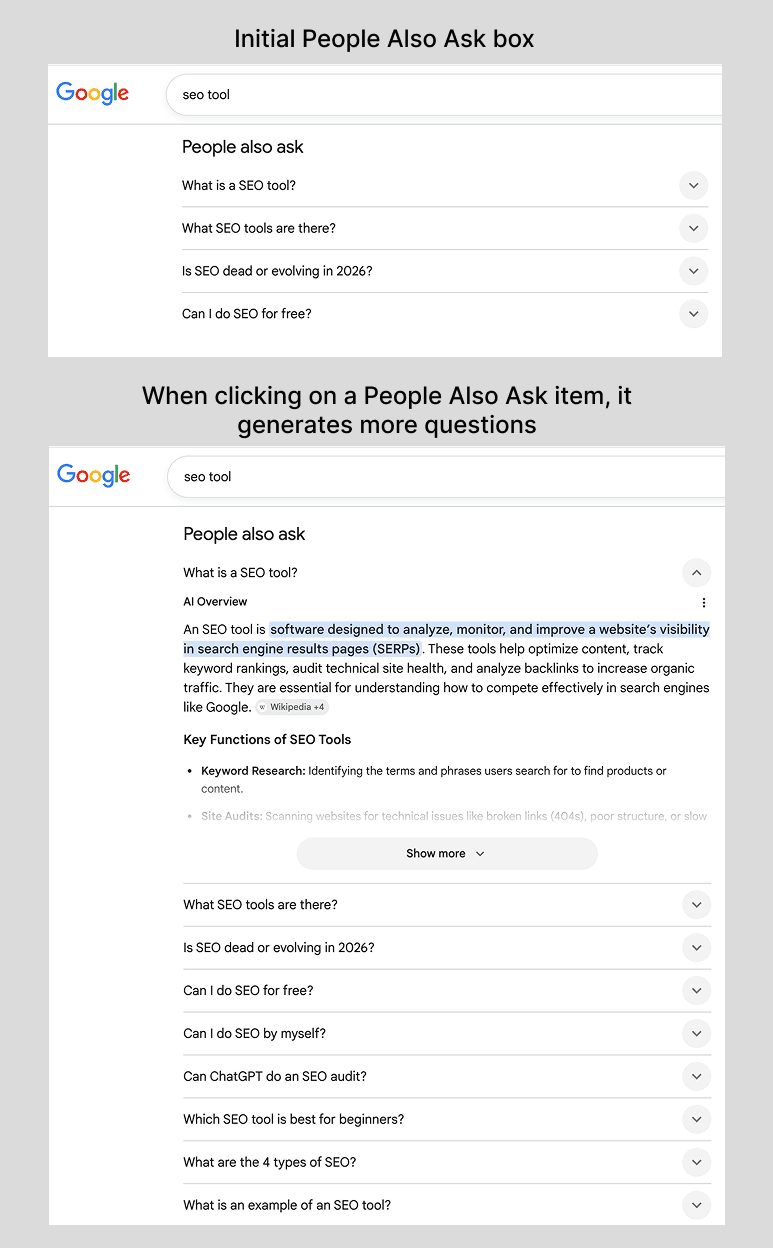
When the user clicks on a question, the accordion expands to reveal a snippet-length answer (typically 40 to 60 words), the page title and URL of the source, and sometimes a thumbnail image. Crucially, clicking a question causes Google to dynamically generate 2 to 4 additional questions at the bottom of the PAA box. This creates a cascading, "rabbit hole" effect that can theoretically continue indefinitely.
The questions that appear in a PAA box are not hardcoded. Google’s search systems use natural language processing to understand semantic relationships between topics. Updates such as BERT and MUM show Google’s broader move toward understanding meaning, context, and related intent, although Google does not publish the exact system used to generate every PAA result. The algorithm generally works in two parts: Question Selection and Answer Extraction.
For Question Selection, Google analyses:
For Answer Extraction, Google selects a specific page to pull the snippet from based on:
Unlike featured snippets (which almost always appear at the very top), PAA boxes can appear in almost any position on the results page. For some queries, the PAA box shows in position 2; for others, it doesn't appear until position 6 or later. For a small number of queries, PAA doesn't show on the first page at all. This variability means you cannot assume a fixed position when planning your SERP strategy.
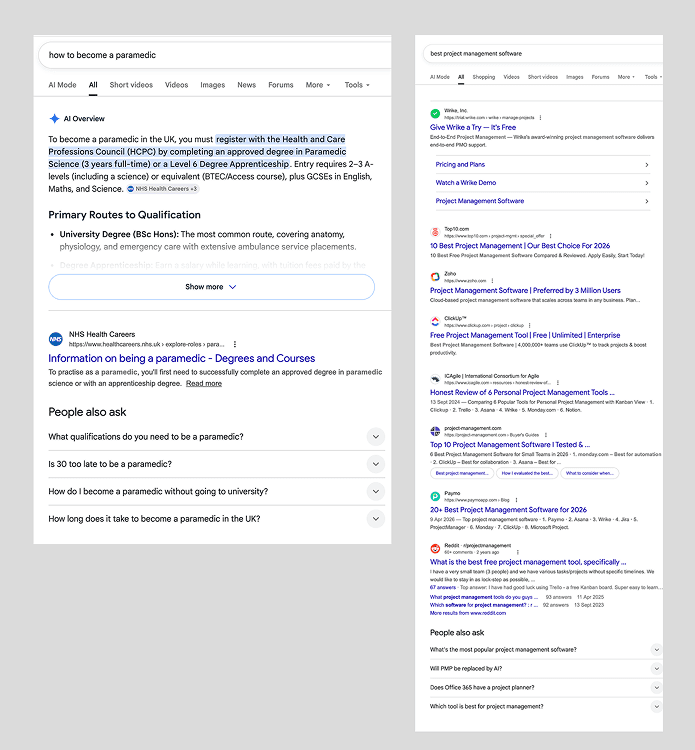
A critical insight for SEO strategy: Google often pulls the answer to a specific PAA question from the same source page, even when that question appears across different search queries. For example, if Google selects your page as the source for "What is keyword difficulty?", it will likely use your page as the source for that question whether the user searched for "keyword research," "SEO tools," or "how to rank on Google."
This means a single well-optimised answer can accumulate visibility across hundreds of different search queries. It also means that PAA answers are relatively stable once won — Google tends to keep the same source until a significantly better answer appears. For SEO teams, this makes PAA tracking useful: if you win a source slot for a recurring question, you may want to monitor whether Google keeps using your page over time.
Understanding the scale and behaviour of PAA requires looking at the data. Here are the key statistics from industry research that quantify PAA's impact on the search landscape:
Source: Ahrefs (2020) / Semrush Sensor (2024)
Source: Backlinko user behaviour study
Source: AlsoAsked data via Search Engine Roundtable
"On average, only 3% of searchers interact with the PAA box. But some queries see interaction rates as high as 13.6%, meaning the value of PAA optimisation varies dramatically by niche and query type."
Industry studies put PAA visibility somewhere around the 40–52% range depending on dataset, country, and date. Ahrefs found PAA boxes on 43% of queries in its 2020 study, while Semrush reported PAA boxes appearing in 51.85% of searches in August 2024.
But visibility does not automatically equal traffic. As Joshua Hardwick at Ahrefs noted, expanding an answer counts as an interaction, but only around 0.3% of searches with PAA boxes result in a click to the source page. This means PAA is most valuable when the exact same question appears across many high-volume searches.
In PeopleAlsoAsked’s own dataset, we see the same broad pattern: PAA appears across a wide range of query types, especially in informational-heavy verticals such as B2B, health, finance, and education. We will publish a dedicated methodology breakdown separately as our dataset grows.
Another critical data point comes from STAT Search Analytics, who found that 32% of questions in PAA boxes have zero measurable search volume. This proves that Google isn't just surfacing popular queries; it is surfacing highly relevant, conceptually linked questions to help users explore a topic, even if those specific question strings are rarely typed into the search bar directly.
People Also Ask has become one of the most impactful SERP features for SEO professionals. Here is why PAA deserves a central role in your search strategy:
52% of all Google searches now display a People Also Ask box (Semrush Sensor, 2024). That figure has grown from ~40% in 2018 to over half of all queries, making PAA the single most common SERP feature after standard organic results.
PAA boxes can appear prominently on the SERP, sometimes above the fold and sometimes further down the page. Winning a PAA slot is equivalent to adding a second listing on the first page, significantly increasing your brand's visible footprint.
PAA questions reveal what your audience actually wants to know. They map the journey from awareness to purchase, showing you the exact information gaps your content should fill.
Google uses PAA to reduce a user's "Time to Result" (TTR)—a concept popularised by the Wix SEO Hub. By clustering related questions (Intent Proximity), PAA predicts what a user will ask next and serves the answer preemptively.
The cascading nature of PAA creates a natural topic map. By expanding questions recursively, you can build comprehensive content clusters that establish topical authority.
Unlike traditional keyword research (which tells you what people search for), PAA data tells you what questions people need answered. This distinction is critical in the age of E-E-A-T (Experience, Expertise, Authoritativeness, and Trustworthiness), where Google explicitly rewards content that demonstrates genuine expertise and addresses real user needs.
"Optimising for PAA boxes can sometimes be worthwhile for high traffic or high-value pages. The key is choosing your battles wisely — target questions that show up across many keywords with high combined monthly search volume."
From a competitive standpoint, PAA also provides intelligence. You can see which domains Google currently trusts to answer specific questions in your niche, and you can reverse-engineer what makes their content citation-worthy.
One of the most common points of confusion in SEO is the difference between People Also Ask (PAA) and People Also Search For (PASF). While they sound similar and both appear on Google's search results page, they serve fundamentally different purposes and provide different types of data.
| Attributes | People Also Ask (PAA) | People Also Search For (PASF) |
|---|---|---|
Format | Expandable question accordions with inline answers | Clickable search query suggestions |
Result of interaction | Answer appears on the SERP (no new search) | Clickable search query suggestions |
Trigger | Appears automatically for most queries | Often appears after a user clicks a result and returns (pogo-sticking) |
Content type | Questions with answers | Related keywords and topics |
SEO value | Content ideation, FAQ creation, featured answer targeting | Keyword expansion, search intent refinement |
Cascading? | Yes; clicking generates more questions | No; static list of suggestions |
In practical terms: use PAA data to understand what questions your audience needs answered (ideal for FAQ sections, long-form guides, and content briefs). Use PASF and Related Searches data to understand what related topics and keywords your audience explores (ideal for keyword expansion and internal linking strategy).
The most effective SEO strategies use both features together. PAA maps the questions; PASF maps the adjacent search landscape. Together, they give you a comprehensive view of user intent and topic coverage. PeopleAlsoAsked provides dedicated tools for both — see our Related Searches feature for the PASF side.
The launch of Google's AI Overviews in 2024 has fundamentally changed the SERP landscape. But rather than replacing PAA, the two features have become deeply intertwined. Understanding this relationship is critical for any modern search strategy.
Semrush’s 2025 AI Overviews study found that People Also Ask appeared alongside AI Overviews on 90.03% of analysed AI Overview SERPs, making the two features highly likely to co-occur. AI Overviews typically provide a synthesised summary at the top of the page, while PAA boxes offer a structured, question-based exploration path below. The two features serve complementary user needs: AI Overviews for the "quick summary," PAA for the "deeper exploration."
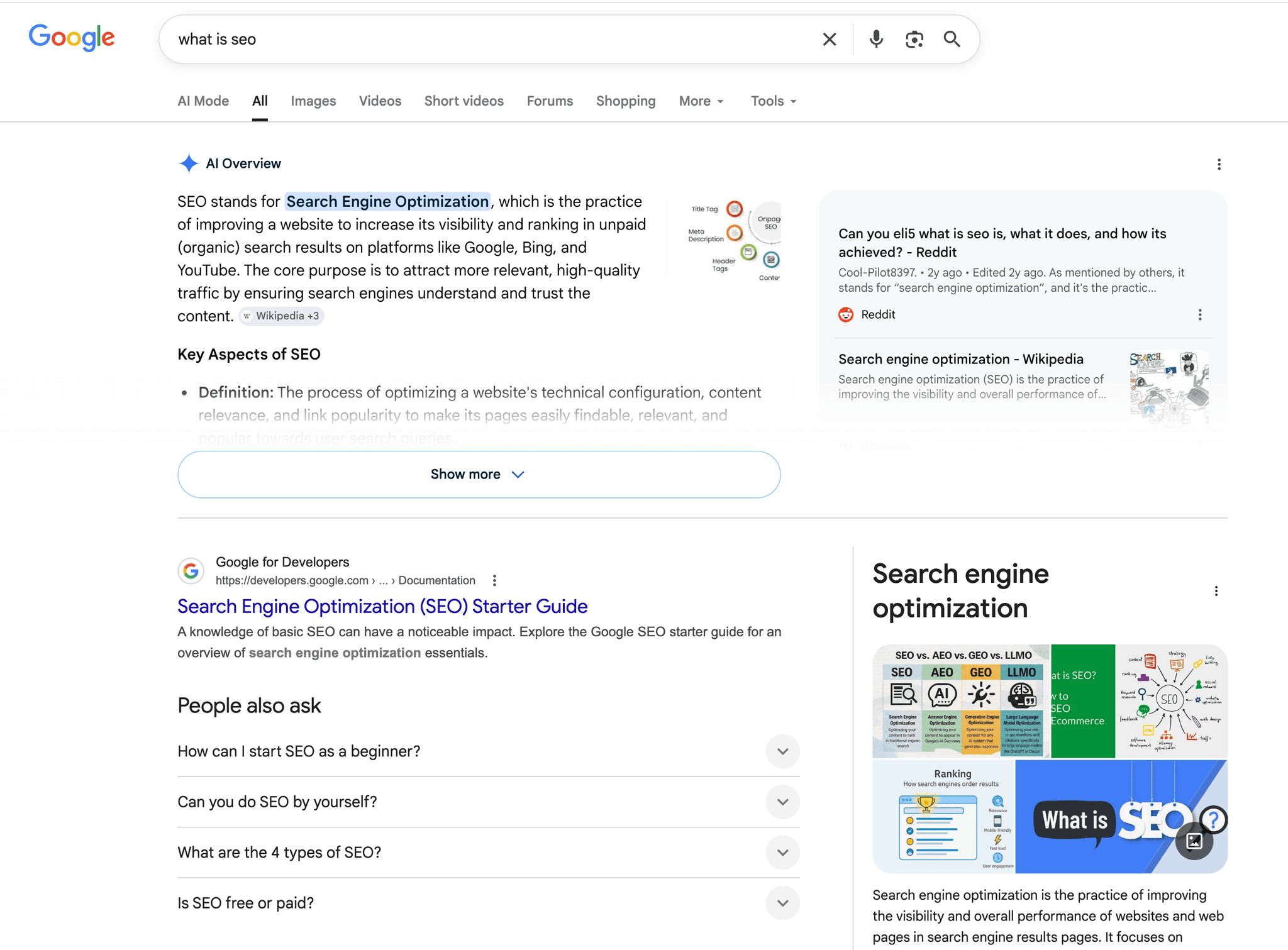
An increasing proportion of PAA answers are now generated by Google's AI systems rather than extracted from a single third-party webpage. In October 2025, Search Engine Roundtable reported AlsoAsked data showing that 38% of English-language PAA answers were labelled as AI-generated, up from 17.8% a few months earlier. For SEOs, this means that while earning a PAA placement is still valuable, the competitive landscape is shifting: you are now competing with Google's own AI as well as other websites.
The principles that help your content get selected for PAA boxes are the same principles that make your content citable by AI engines like ChatGPT, Gemini, Perplexity, and Claude. This convergence is sometimes called Generative Engine Optimisation (GEO). The shared principles are:
While you can manually expand PAA boxes on Google, the cascading nature of the feature makes manual research extremely time-consuming. Dedicated tools automate the discovery, mapping, and export of PAA questions at scale.
Purpose-built for PAA research. Recursively expands PAA boxes across multiple levels, enriches questions with volume, difficulty, and intent data, and exports to CSV. See how we compare to AlsoAsked and AnswerThePublic.
Tools like Ahrefs, SEMrush, and Moz include PAA data as part of their SERP analysis features, though typically limited to first-level questions without recursive expansion.
For small-scale research, you can manually search your target keywords on Google and expand the People Also Ask questions yourself. This is free and useful for understanding how Google connects questions around a topic, but it quickly becomes repetitive if you want to collect, organise, or compare questions across multiple searches.
To make this easier, we built the free PeopleAlsoAsked browser extension. It works directly on Google Search, helping you extract People Also Ask questions from the SERP without needing an account or using the full web app.
Why use the free extension?
The extension is best for quick research, live SERP checks, lightweight question discovery, and exporting what you find directly from Google.
Need more research depth?
The PeopleAlsoAsked web app is built for more structured keyword and content research. It gives you a dedicated workspace for exploring PAA alongside other search discovery methods, enriching questions with useful SEO data, and saving research over time.
With PeopleAlsoAsked Pro, you can access:
Use the extension when you want a fast, free way to extract PAA questions from Google. Use the full PeopleAlsoAsked app when you need enrichment, more search types, saved research, and tracking.
Google typically displays 4 PAA questions initially. As you click to expand questions, Google dynamically adds more related questions to the bottom of the list. In theory, this cascade can continue indefinitely, though users typically see between 4 and 15 questions in a session.
No. PAA questions are localised by country, language, and sometimes even city. A search for the same keyword in the US and UK will frequently return entirely different PAA questions. This is why location-specific PAA research is essential for international SEO campaigns.
PAA results are surprisingly dynamic. Google can update the questions shown and the sources selected multiple times per week. Major algorithm updates and trending search patterns both influence which questions appear and which pages are featured.
No. PAA boxes are entirely organic. Google selects the source pages algorithmically based on content relevance, authority, and structure. You cannot buy a placement, though you can improve your chances significantly by formatting your content as direct, well-structured answers to common questions.
A featured snippet answers the primary search query and appears at the very top of the results (position zero). PAA boxes contain multiple related questions, each with their own concise answer. A page can appear in both a featured snippet and a PAA box for different queries. PAA also appears for a much wider range of searches than featured snippets.
Increasingly, yes. Research from 2025 suggests that approximately 38% of PAA answers are now AI-generated rather than extracted directly from a single third-party webpage. However, PAA boxes still link to source pages, and the principles for earning those placements remain the same: clear, authoritative, well-structured content.
PAA answers come in several formats: paragraphs (the most common), bulleted or numbered lists, tables, and occasionally videos. The format Google selects depends on the type of question. "What is" questions typically get paragraph answers, "how to" questions often get lists, and comparison questions may get tables. Matching your content format to what Google expects for a given question significantly increases your chances of being selected as the source.
PeopleAlsoAsked recursively maps every question Google's PAA boxes return for your keywords, with enrichment data included.